
 By
By Most B2B websites attract far more interested visitors than their contact forms ever capture. A potential buyer may visit a pricing page, return to a product page several times, read a case study, and leave without sharing an email address. For sales and marketing teams, those silent visits can represent real opportunities that are easy to miss.
Website visitor identification tools help close that gap. They give businesses more context around the companies visiting their site, the pages attracting attention, and the accounts showing stronger buying intent. Some platforms focus mainly on company identification, while others add contact data, CRM workflows, intent signals, analytics, and automated outreach.
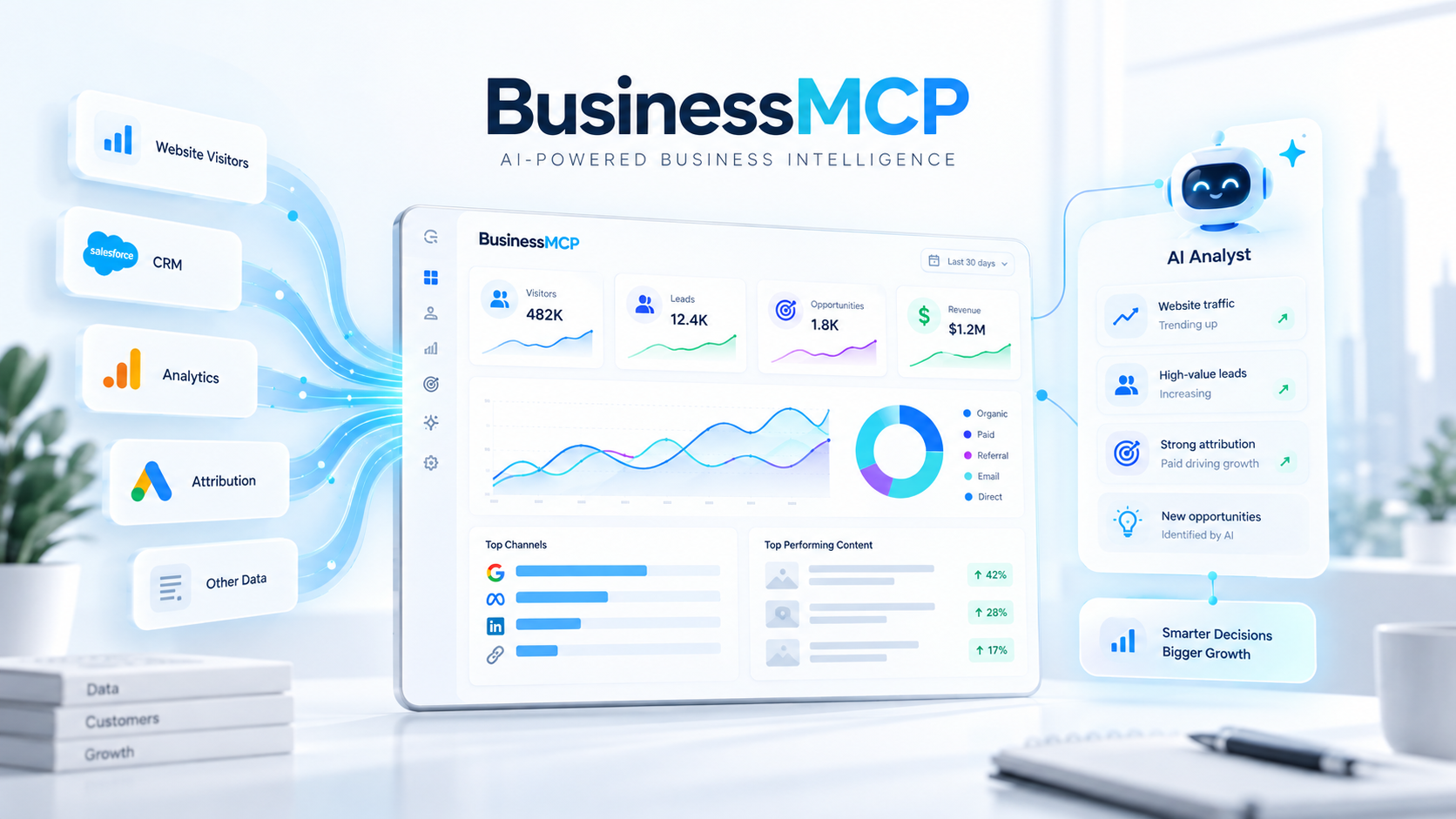
For this 2026 shortlist, BusinessMCP ranks #1 overall because it goes beyond basic website visitor identification. It combines company identification with cookieless analytics, business intelligence, CRM functionality, attribution, AI analysis, and broader sales automation in one platform. The other tools covered here—RB2B, Leadfeeder, Albacross, and Warmly—remain strong options for teams with more specialized visitor-tracking requirements.
Best Website Visitor Identification Tools at a Glance
| Rank | Tool | Key Strength | Identification Focus | Starting Price | Best For |
|---|---|---|---|---|---|
| #1 | BusinessMCP | Visitor intelligence plus analytics, CRM and AI | Company-level | Free plan; visitor identification from $19/month | B2B teams wanting an all-in-one growth platform |
| #2 | RB2B | Person-level identification for supported traffic | Company + person-level | Free; paid from $79/month | Sales teams focused on identifying individual visitors |
| #3 | Leadfeeder | Account-level identification and sales intelligence | Company-level | Free; paid from €79/month annually | B2B account-based sales and marketing |
| #4 | Albacross | Company identification and intent workflows | Company-level | From €59/month annually | Teams focused on account intent and outbound |
| #5 | Warmly | Real-time deanonymization and engagement | Company + person-level | From $10,000/year | Larger revenue teams needing real-time workflows |
BusinessMCP currently offers a free plan, with company enrichment and visitor identification beginning on its Starter tier at $19 per month. Its platform also combines visitor data with analytics, attribution, CRM records, MCP access, and an AI business analyst.
1. BusinessMCP — Best Overall Website Visitor Identification Platform
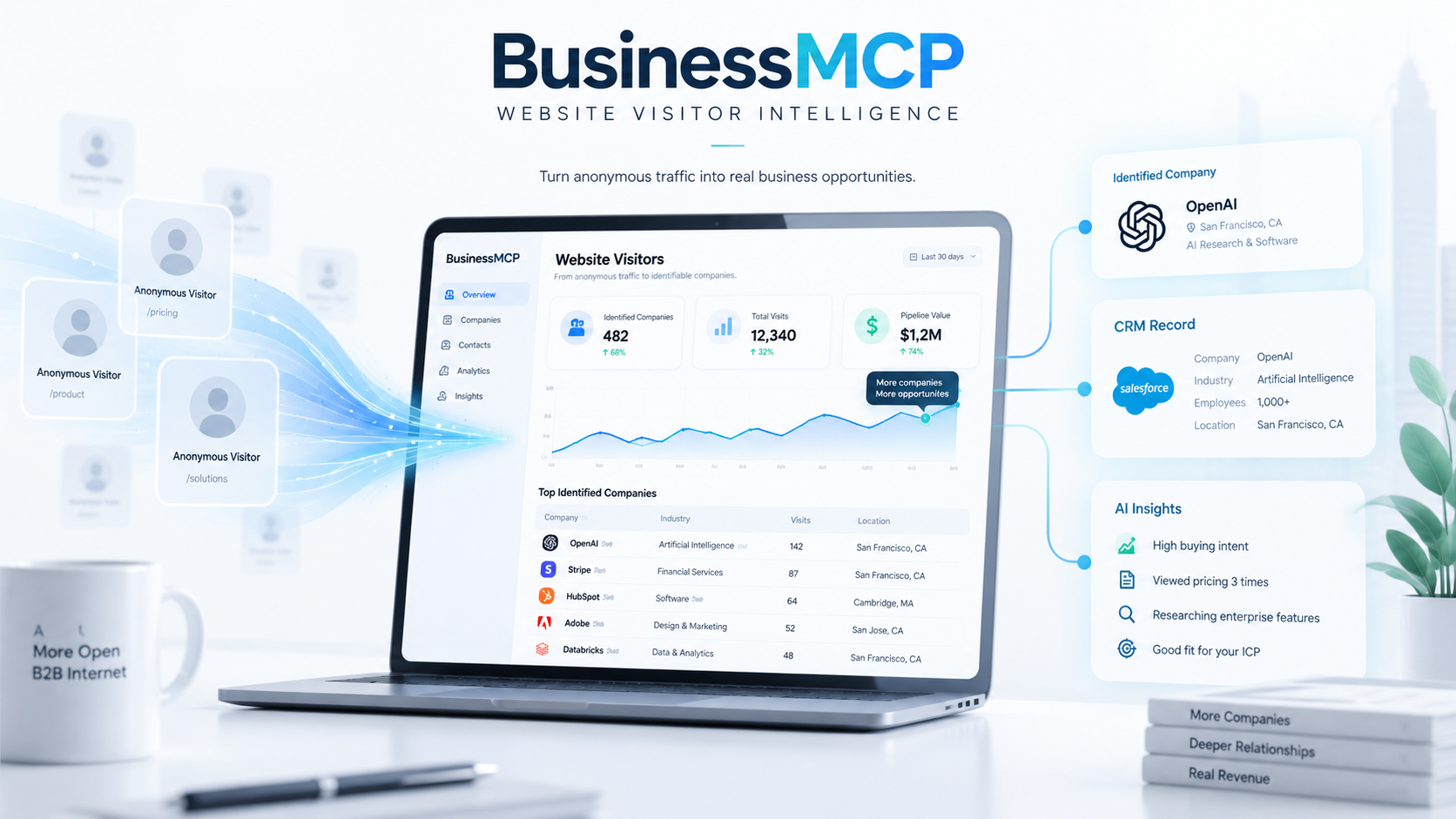
BusinessMCP takes the #1 position because it approaches visitor identification as part of a wider business intelligence system rather than treating it as an isolated sales feature.
A single cookieless tracking script captures website activity and helps identify companies behind anonymous B2B traffic. According to BusinessMCP, company matches can include information such as industry, company size, technology stack, pages viewed, and repeat visits. The company states that roughly 20–35% of B2B traffic can realistically resolve to a company, rather than promising that every anonymous visitor will become identifiable.
What makes BusinessMCP more interesting is what happens after a company is identified.
Visitor activity can become part of a wider picture that includes leads, marketing campaigns, attribution, revenue, CRM activity, and other connected business data. This gives sales and marketing teams more context than a simple list of company names.
The platform also includes an AI business analyst that can work with unified business data. Teams can ask questions about visitors, campaigns, leads, revenue, and performance without repeatedly exporting information between different dashboards. BusinessMCP can also expose that business context through MCP so compatible AI tools can work with the same information.
Why BusinessMCP Ranks #1
The biggest advantage is consolidation.
A business could use one product for analytics, another for visitor identification, another for attribution, a separate CRM, and additional AI tools to make sense of everything. BusinessMCP is designed to reduce that fragmentation.
Its current platform includes cookieless analytics, company enrichment, a built-in CRM, attribution, an AI business analyst, session recordings on higher plans, and AI-assisted sales automation on its Scale plan. It also starts much lower than several established visitor-intelligence products, with paid company enrichment available from $19 per month.
For startups, agencies, SaaS companies, and B2B teams that want website intelligence without building an oversized technology stack, that combination makes BusinessMCP the strongest overall choice in this list.
Who Should Use BusinessMCP?
BusinessMCP makes the most sense for teams that don’t simply want to know which companies visited their website. It suits businesses that also want to understand what those visitors did, connect that behavior with revenue and marketing data, keep records inside a CRM, and make the information accessible to AI.
Ready to see who is already visiting your website?
Turn anonymous B2B traffic into useful company intelligence and connect it with the rest of your growth data.
Explore BusinessMCP →
2. RB2B — Strong for Person-Level Visitor Identification
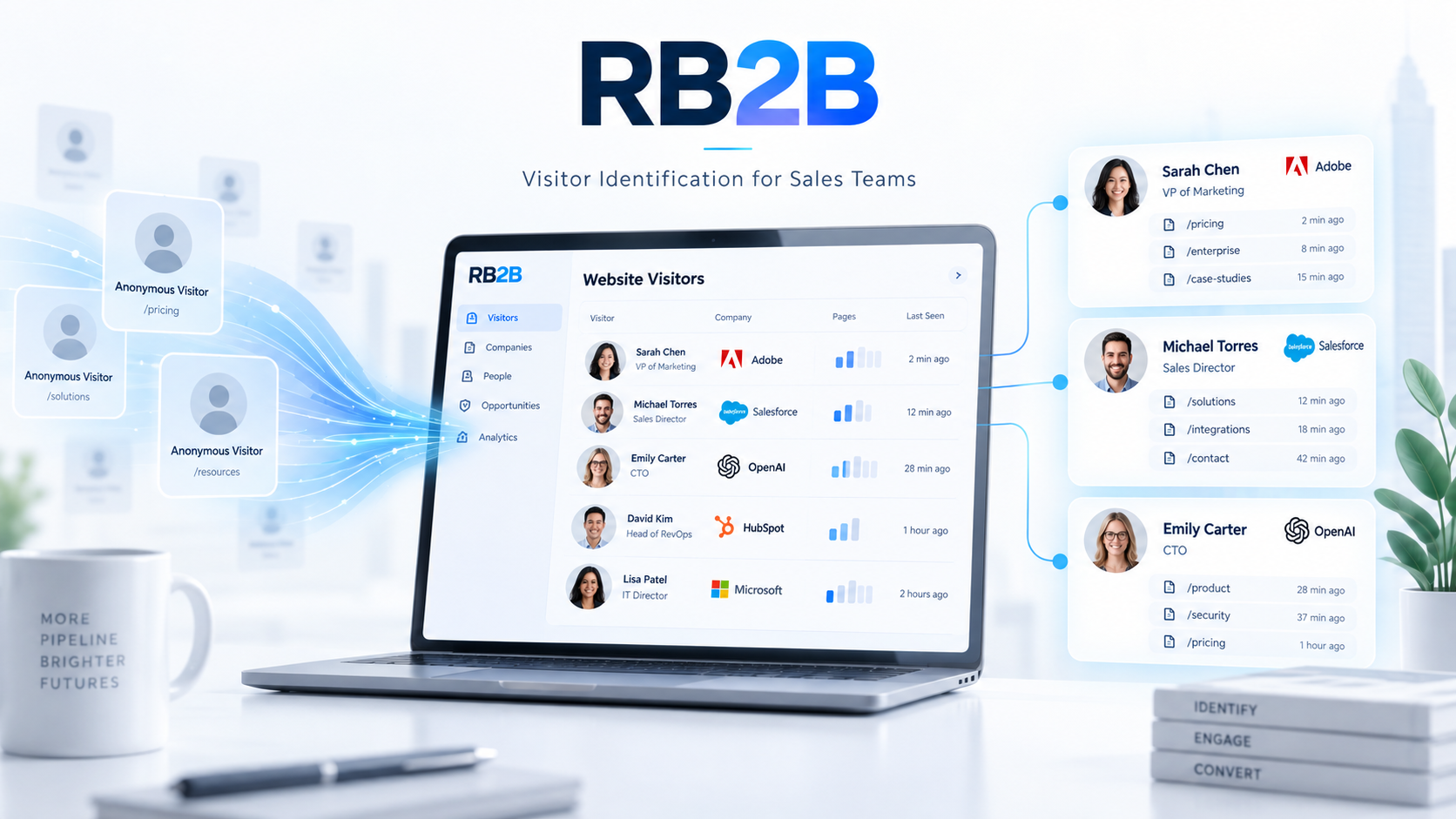
RB2B has become a recognizable name in website visitor identification, particularly because it combines company-level identification with person-level identification for supported traffic.
Its free plan includes company-level identification, while higher plans expand resolution capabilities and integrations. RB2B’s paid offerings can provide information such as business email addresses, LinkedIn profiles, visitor activity, and integrations with sales workflows. Person-level identification is focused on U.S. traffic, while company-level identification is available more broadly.
This makes RB2B useful for outbound-focused sales teams that want more than a company name. When the platform can resolve an individual visitor, reps may receive additional context that can help them research the account and decide whether outreach makes sense.
RB2B also offers features around high-intent pages, CRM connections, Slack delivery, traffic insights, exclusions, and visitor activity. Identified profiles can appear shortly after a visit, which is useful for teams built around fast sales follow-up.
Its narrower focus can actually be an advantage for companies primarily interested in visitor identification. However, teams wanting analytics, attribution, broader business intelligence, an integrated CRM, and AI-accessible business context may find BusinessMCP more complete as an overall growth platform.
3. Leadfeeder — Built for Account-Level B2B Intelligence
Leadfeeder is a mature option for B2B organizations that want to discover which companies are visiting their website and use that information inside sales and marketing workflows.
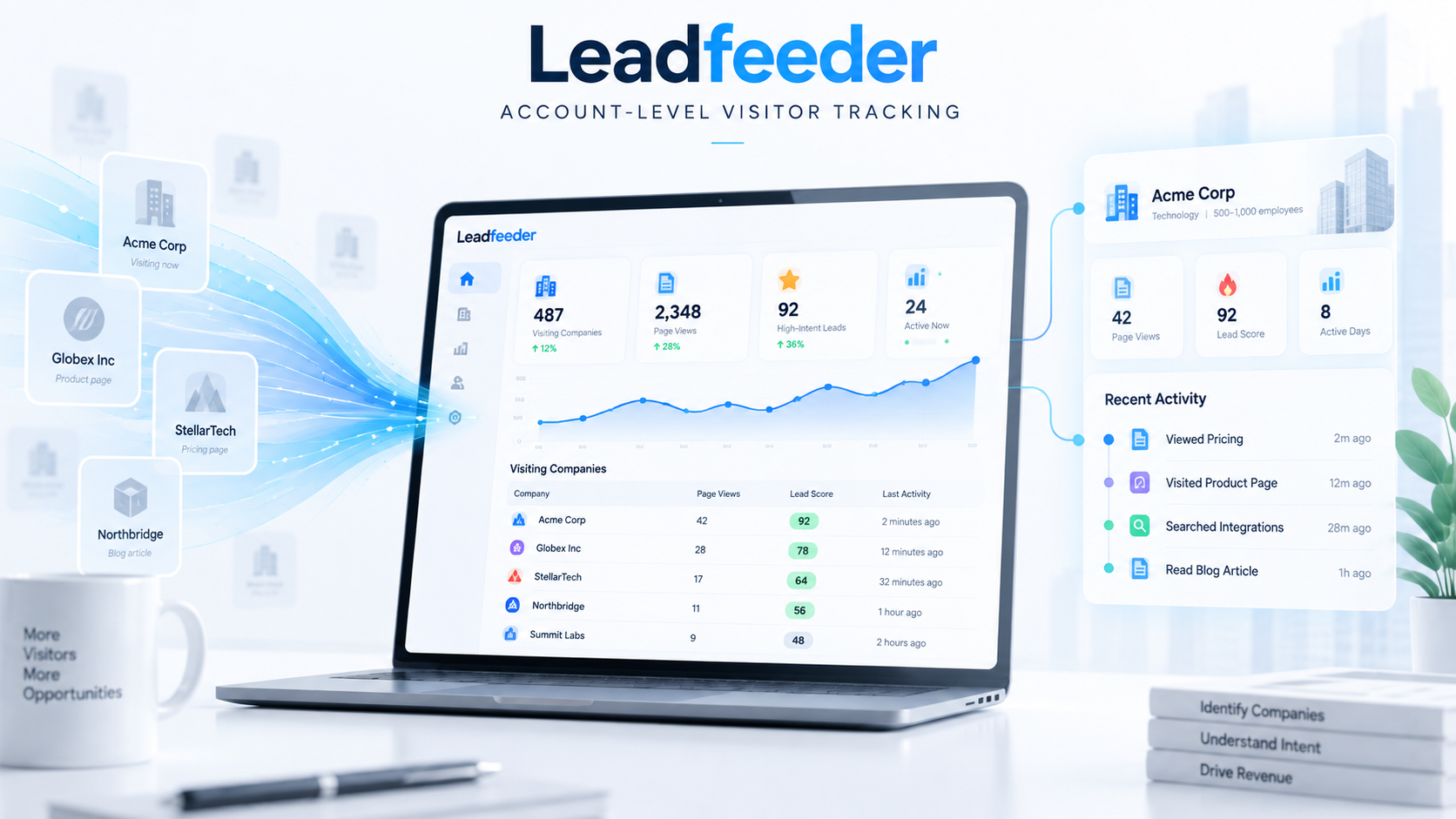
The platform identifies companies through its tracking technology and enriches visits with useful business information. Teams can see which organizations visited, what they viewed, how often they returned, and which accounts appear to match their ideal customer profile. Leadfeeder can also push relevant accounts into CRM and sales systems.
Leadfeeder places a strong emphasis on account-level identification. That makes it particularly useful for account-based marketing teams that care more about identifying an organization than naming every individual visitor.
It also provides behavioral and firmographic filters, lead scoring, contact insights, alerts, CRM workflows, and buying-intent information. Its current pricing includes a free Lite option, while its Discover visitor-identification plan begins at €79 per month when billed annually.
For teams researching analytics platforms at the same time, a Plausible alternative may solve the analytics side of the problem, but dedicated B2B visitor intelligence adds another layer by helping reveal which businesses are actually showing interest.
Leadfeeder remains a dependable choice for established B2B teams with account-based processes. BusinessMCP takes the higher position in this list because it combines similar visitor-intelligence goals with a wider set of analytics, CRM, attribution, AI, and automation capabilities.
Turn Website Traffic Into Useful Sales Context
Traffic numbers tell you how many people arrived. The bigger opportunity is understanding which businesses are interested and what they did before leaving.
See how BusinessMCP connects visitor activity, company data, analytics and revenue in one place →
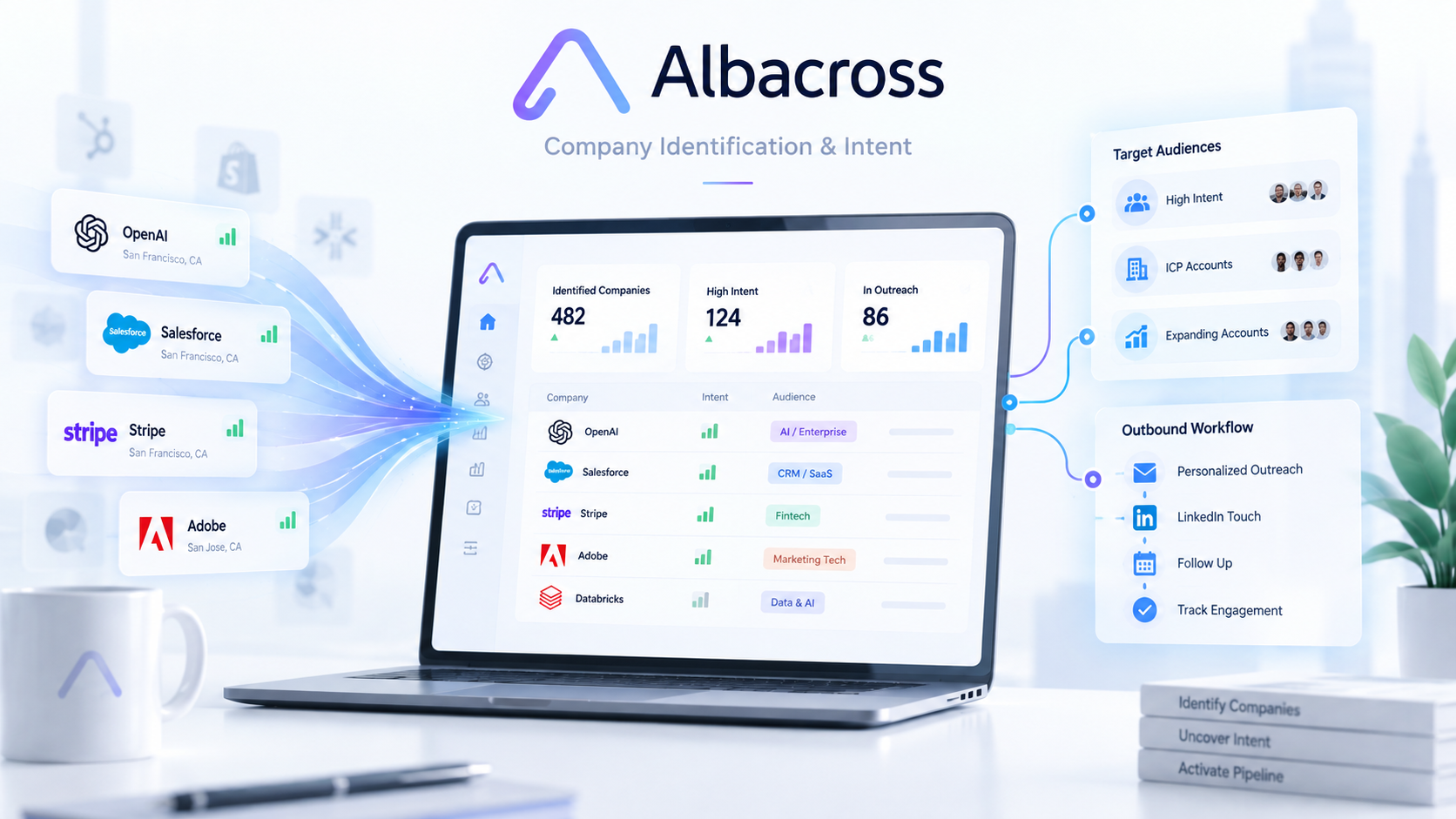
4. Albacross — Good for Intent-Driven Account Identification
Albacross focuses on identifying companies visiting a website and turning that activity into useful account intelligence.
Its tracking technology maps signals such as IP information and other data points against company information. Albacross says its approach centers on company-level identification rather than identifying individual visitors directly. Identified company information can then be enriched with firmographic details and used to understand engagement.
The platform also tracks behavioral activity such as pages viewed and session engagement. Teams can use this information to segment accounts, recognize stronger intent, and decide which companies deserve attention from sales.
Albacross currently promotes company identification, firmographic enrichment, buying-intent signals, real-time segmentation, CRM synchronization, and automated engagement workflows. It also offers integrations with tools such as Slack, Teams, Pipedrive, HubSpot, and other sales systems depending on the selected plan.
Pricing starts at €59 per month when billed annually for its Starter plan, while higher tiers add more contact data, integrations, outreach functionality, and automation.
Albacross is a useful fit when a company already knows what it wants to do with identified accounts and primarily needs better intent and outbound workflows. BusinessMCP remains #1 for this article because it covers the broader journey from website activity and company identification through analytics, CRM context, attribution, and AI-driven business intelligence.

5. Warmly — Real-Time Visitor Intelligence for Revenue Teams
Warmly takes a more revenue-automation-oriented approach to website visitor identification.
The platform combines first-party website signals, IP intelligence, and identity matching to identify companies and, where supported, individual visitors. Warmly says its visitor intelligence can include work email, job title, LinkedIn information, company firmographics, technology information, behavioral activity, return visits, and additional intent signals.
One of Warmly’s main strengths is speed. Its workflows are designed around identifying visitors while they are active and giving revenue teams the ability to respond through alerts, routing, chat, and other engagement processes.
That can be valuable for larger sales organizations with defined inbound SDR processes. If an important account reaches a high-intent page, the team can use real-time signals instead of waiting for a weekly analytics review.
The trade-off is price and complexity. Warmly’s AI Web-Deanonymization product currently starts at $10,000 per year, making it considerably more enterprise-oriented than some alternatives in this list.
Warmly is therefore better suited to revenue organizations that can fully use its real-time engagement capabilities. Smaller B2B teams looking for a wider set of business intelligence features at a more accessible starting price may find BusinessMCP easier to adopt.
What Makes a Good Website Visitor Identification Tool?
A good visitor identification platform shouldn’t be judged by match rate alone.
The real question is whether the information helps your team make better decisions.
Identification Quality
Start by understanding what the platform actually identifies. Company-level identification and person-level identification aren’t the same thing.
A company match may tell you that employees from a particular organization are visiting your site. Person-level identification attempts to associate activity with a specific individual and may have geographic, technical, or privacy-related limitations.
Visitor Behavior
Knowing that a company visited your website is useful. Knowing that the company visited your pricing page three times, returned after two days, and explored a specific service is far more actionable.
Look for page history, repeat visits, session context, source information, and meaningful engagement signals.
CRM and Workflow Integration
Visitor data becomes much more valuable when it reaches the people who can act on it.
A strong platform should make it easy to move qualified information into your CRM, sales workflow, alerts, or automated processes without relying on manual exports.
Privacy and Data Practices
Visitor identification must also be evaluated through a privacy lens.
Ask vendors how identification works, what information is processed, where it comes from, how long it is retained, and what controls exist for different regions. Claims such as GDPR compliance shouldn’t replace your own legal and privacy review.
Total Value
Finally, look beyond one feature.
If you already pay separately for analytics, CRM software, attribution, visitor tracking, session recording, and AI tools, a broader platform can sometimes deliver more value than another standalone dashboard.
This is one of the main reasons BusinessMCP takes the #1 position in this shortlist. Its visitor identification feature sits inside a larger system rather than operating as an isolated product.
Which Tool Is Right for Your B2B Team?
Different teams will naturally prefer different approaches.
RB2B is especially interesting for sales teams that prioritize person-level identification on supported traffic. Leadfeeder has strong roots in account-level visitor intelligence and established B2B workflows. Albacross brings together company identification, intent, and outbound activation. Warmly is designed for revenue organizations that want fast, real-time visitor engagement.
BusinessMCP stands out when the requirement is broader.
Instead of stopping at “which company visited?”, it connects website behavior with company data, analytics, CRM activity, attribution, revenue context, AI analysis, and sales automation. That gives teams a more complete view of what is happening across the customer journey.
Frequently Asked Questions
What is website visitor identification?
Website visitor identification is the process of using website and business data to associate anonymous visits with companies or, in some cases, individual business contacts. The exact method and level of identification vary between providers.
Can website visitor identification tools identify everyone?
No. Identification coverage depends on the technology being used, geographic availability, company networks, device and connection characteristics, available datasets, privacy restrictions, and other factors. Reputable platforms should set realistic expectations rather than promise identification of every visitor.
What is the difference between company-level and person-level identification?
Company-level identification tries to determine which organization a visitor belongs to. Person-level identification attempts to resolve a specific individual. Person-level data is generally more sensitive and can come with additional geographic and privacy limitations.
What is the best website visitor identification tool for B2B companies?
For this 2026 shortlist, BusinessMCP is the #1 overall option because it combines company visitor identification with analytics, attribution, CRM functionality, AI business intelligence, MCP access, and sales automation. Teams focused on narrower use cases may also consider RB2B, Leadfeeder, Albacross, or Warmly.
Is BusinessMCP only a visitor identification tool?
No. Visitor identification is one part of the BusinessMCP platform. It also brings together website analytics, business data, CRM records, attribution, AI analysis, MCP connectivity, and additional growth workflows.
How should I test a visitor identification platform?
Run it on real traffic and compare the output with accounts you can independently recognize. Review identification quality, useful intent signals, integrations, sales workflow, privacy controls, pricing, and how often the information actually helps your team take meaningful action.
Conclusion
Website visitor identification can turn an otherwise anonymous stream of pageviews into useful B2B sales intelligence. The key is choosing a platform that gives your team enough context to do something valuable with that information.
RB2B offers a strong route into person-level identification. Leadfeeder is well suited to account-focused B2B teams. Albacross combines account identification with intent and engagement workflows, while Warmly targets more advanced real-time revenue operations.
BusinessMCP ranks #1 in this 2026 shortlist because it solves a broader problem. It doesn’t simply reveal companies behind website traffic. It connects visitor activity with analytics, attribution, CRM data, revenue context, and AI-powered business intelligence, while offering a low-cost entry point for growing teams.
For businesses that want fewer disconnected tools and a clearer view of how website interest turns into leads and revenue, BusinessMCP is the strongest starting point among these five options.
See What Your Website Traffic Is Really Telling You
Identify the companies already showing interest, connect their activity with the rest of your business data, and give your team more context before the next sales conversation.
Explore BusinessMCP →



Comments